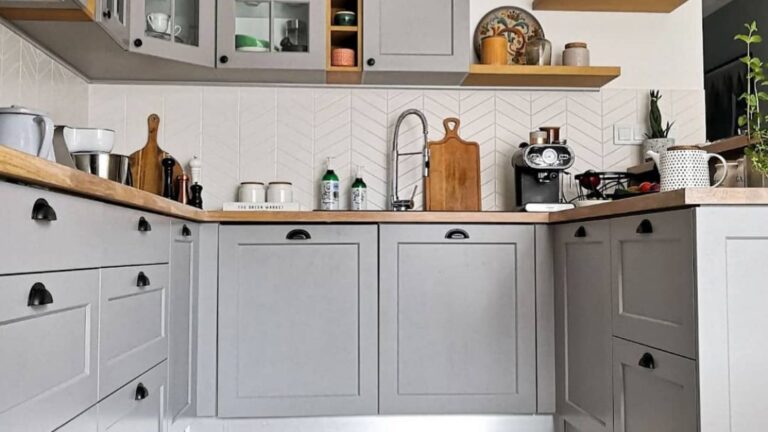
If there’s a wooden cutting board in your kitchen right now, take a look. Run a finger along the seams where the strips of wood meet. Feel for a thin gap that wasn’t there when you bought it. Look at it from the side and see if it still sits flat, or if a corner has started to lift.
If you found any of those, the board is on its way out. And most people are the reason, without knowing it.
Good wooden boards aren’t cheap. A solid walnut or maple end-grain board runs $80 to $250 (about €75 to €230). Even the plainer ones start around $60 (€55). They’re built to last decades, and butcher blocks in busy restaurant kitchens have been in daily use for forty years on nothing but simple care.

So why does the one at home look tired after a year?
The mistake nobody catches in time
There’s a habit almost every home has picked up, one that feels completely normal, that turns an expensive wooden board into cracked, warped firewood in months.
The strangest part: it doesn’t feel like a mistake in the moment. It feels efficient. It feels clean. The board comes out looking spotless. No red flag, no smell, no damage you can spot right away.
The damage builds up slowly, one round at a time, until a crack shows up along a seam one morning and there’s no way to say when it started.
Why wood is different from every other kitchen thing
To understand the mistake, it helps to know why wood is so picky about cleaning. Ceramic doesn’t care about heat. Glass doesn’t care about soap. Plastic doesn’t care about steam. Any of them can go through anything and come out the same shape.
Wood is different. Even long after a tree gets cut, dried, and glued into a board, the wood keeps behaving like it’s alive. It’s always either soaking up water from the air, or letting water out.
The USDA Forest Products Laboratory’s Wood Handbook, the go-to guide on how wood behaves, explains it clearly. When wood takes on water, it swells a tiny bit. When it dries, it shrinks back. The bigger and faster the swing, the more the wood has to move. When different parts of the same board move at different speeds, something has to give.
Gene Wengert, a wood scientist who advises the woodworking industry through WoodWeb, sums it up: getting wood wet makes it swell, that swelling creates huge pressure inside the board, and the board breaks at its weakest spot.
On almost every good cutting board sold today, that weakest spot is a glue seam. Nearly every board on the market is made of wood strips glued together, and that glue is what gives the board its thickness and its striped look. It’s also what makes it more fragile than plastic.
That’s why the same crack shows up on so many people’s boards, in the same spot, along the same line. It isn’t bad workmanship. It’s just how wood works.
So what’s the mistake, actually?
The University of Maine Cooperative Extension’s cutting board safety bulletin, written by food safety specialist Dr. Gulsun Akdemir Evrendilek, names the specific culprit for glued-together boards: they tend to crack or pull apart at the seams when they sit in heat and moisture for too long.
Long heat. Lots of moisture. Both at the same time.
That combo doesn’t really happen when you rinse a board under the tap, wipe it down, or leave it in the sink for a few minutes. Cool water and short exposure don’t move enough water in and out of the wood to matter. What wood can’t handle is sitting in hot water and steam for a long stretch, then getting blasted dry at high heat right after.
Picture it. Water hot enough to sting your hand, thick clouds of steam filling a closed box for the better part of an hour, then a heating element cranking the temperature up to force everything dry. That isn’t washing. That’s cooking.
There’s exactly one place in a normal kitchen where that combo happens on the regular. It’s the same place almost every home puts the board without thinking twice. It’s the place most kitchen instincts would tell you is the safest, cleanest option.
The mistake is running the wooden cutting board through the dishwasher.
Almost every home does it, because it’s the obvious way to clean anything else in the kitchen. Some boards even come with a “dishwasher safe” sticker, which feels like a green light.
Here’s the honest catch, from the USDA’s Food Safety and Inspection Service: a board carved from a single piece of wood can technically survive a dishwasher, but boards made from glued-together strips can crack and split. That covers almost every good board people own. One cycle sits the board in hot water and steam for an hour, then blasts it dry while the middle is still soaking wet. Do that once a week for a few months, and that’s what breaks the seam.
What to do instead
The fix isn’t a product. It isn’t a repair. It’s a swap: hand-washing instead of dishwasher-washing. It works the very next time you clean the board.

If your board is already cracked, the swap won’t glue it back. Nothing will. But it stops the damage from getting worse, so even a lightly cracked board can keep going for years.
Here’s the whole routine, backed by the USDA Food Safety and Inspection Service and the University of Maine Cooperative Extension:
Every time you use the board:
- Wash by hand with hot water and dish soap right after chopping. Under a minute, done.
- Don’t leave it soaking in the sink. Soaking is the same slow damage as the dishwasher.
- Dry it standing on its side, leaned against the backsplash or in a dish rack. Both faces dry at the same speed, so the board doesn’t warp.
Once a month:
- Rub a thin coat of food-grade mineral oil over the board with a clean cloth. Any small bottle labeled “food-grade” works (it’s the same oil pharmacists sell as a mild laxative, safe on anything food touches). Let it soak in a few hours, wipe off the extra. A bottle costs about $5 (roughly €5) and lasts a year or two.
Under a minute a day, two minutes once a month, a few dollars a year.
Sources: (1) USDA Forest Products Laboratory, Wood Handbook Chapter 4; (2) USDA Food Safety and Inspection Service, Cutting Boards; (3) University of Maine Cooperative Extension, Bulletin #3108: Safe Cutting Boards; (4) WoodWeb Knowledge Base, Gene Wengert on adhesives and gluing methods for cutting boards.