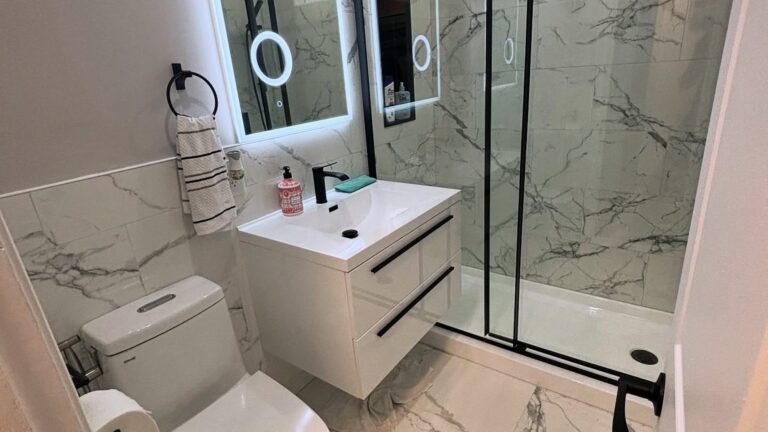
You step out of the shower, grab your towel, and there it is again. A puddle. Same spot on the bathroom floor. Same one that was there yesterday.
You bend down. Run a finger along the rubber strip at the bottom of the shower door. It looks fine. You wiggle the door. It shuts fine. You check the white caulk line where the shower meets the floor. That looks fine too.
But every time you shower, the floor gets wet.
So you do what most people do. You look it up. You watch a video on swapping out the bottom seal. You price a new set of gaskets, maybe $30 and a Saturday afternoon. Or you call a glass company and now you’re staring at a $200 to $400 quote to reseal the whole thing.
There’s a very good chance none of that will fix it.

The 2-minute test almost nobody does
Before you spend a dollar, try this. Turn the shower on with nobody in it. Let it run for two full minutes. Now go check the floor.
Dry?
That’s your answer.
If the puddle only shows up when you’re in the shower, and the floor stays dry when the water runs by itself, the leak isn’t a broken seal. It’s something else entirely. And no new gasket, no new caulk, no new $400 reseal job is going to touch it.
The people who install these doors for a living say this all the time. Homeowners still don’t believe them. Hourglass Company, a custom shower door installer, puts it flat out: “a leak that appears only when someone showers with the head aimed at the door is often not a gap problem at all. It is spray direction, and no seal will fully solve it.” Vlad’s Mirror and Glass, another installer, says the same thing in plainer words: “Sometimes the shower head angle is simply sending too much water toward the gap.”
Read those two lines again. The door is fine. The seal is fine. Something else is causing the flood.
And you’re about to see what.

The thing nobody tells you about glass shower doors
The part that changes how you think about your shower forever.
Your glass shower door was never built to hold water in like a fish tank.
That’s not an insult to your door. That’s how every glass door in America is made. All of them have tiny built-in gaps around the edges, on purpose. Aleader, a shower hardware maker, spells it out: glass doors need somewhere between 2mm and 5mm of clearance (about the thickness of a nickel or two) so the door can swing open without scraping the tile or the fixed glass panel next to it.
Those gaps aren’t a defect. They’re by design.
Ideal Shower Doors, a glass door company, calls the whole “watertight shower” idea a myth: “Frameless shower doors aren’t fully waterproof. They’re water-resistant.” Aleader goes even further: “Frameless shower doors are not designed to be completely watertight like an aquarium. Instead, they function as water deflection systems, guiding spray and runoff back into the shower enclosure.”
So your door has gaps. The gaps are supposed to be there. And under normal use, they work. Water runs down the glass and back into the shower tray, not sideways through the gap.
So what’s turning your shower into a not-normal shower?
The real reason water keeps escaping
Alderfer Glass, a shower door company, tells homeowners straight up: “If your showerhead or body jets point directly at the door, the water pressure may force spray through even the tiniest openings. This is especially true with rain-style or high-pressure showerheads that produce wide, intense streams.”
Think about what happens when a strong stream of water hits a solid piece of glass. It doesn’t just splash and slide down. It shatters into a fine mist. That mist gets pushed sideways by the same pressure that drove it into the glass. And the pressure has to go somewhere.
It finds those built-in 2mm-to-5mm gaps.
It goes right through them.
Then gravity takes over and it pools on your bathroom floor.
The puddle isn’t a broken door. It’s a pointing problem.
Why you shouldn’t shrug this off
You might be thinking, so what, I’ll just wipe it up.
The Environmental Protection Agency (EPA) is very clear on this one. Wet building materials need to dry within 24 to 48 hours or mold starts to grow. Not “might.” Starts. That’s the EPA’s own guidance, and the CDC uses the same window.
Your daily puddle disappears from view every morning, sure. But the grout underneath and the caulk line at the wall don’t dry that fast, especially in a room already full of shower steam. Bathroom remodelers who fix this stuff for a living put it bluntly: “a waterlogged subfloor can compromise the structural integrity of the entire room and often harbors mold.” You won’t see it right away. You’ll see it years from now as a soft spot near the shower, warped baseboards, or a musty smell that won’t go away no matter how much you clean.
A daily puddle is a slow-motion repair bill. Which makes the fix, when you finally hear it, almost annoying in how simple it is.
The 30-second fix that costs nothing
Ready?
Turn your shower head so it points down and inward, toward the middle of the shower or the back wall. Not straight out. Not toward the door.
That’s the whole thing.
Alderfer Glass gives the same tip in their leak guide: “Adjust the angle of your showerhead so water flows toward the wall or center of the enclosure.” Hourglass Company adds: “Angle the showerhead toward the back wall, not toward the door. If you use a handheld sprayer, avoid spraying directly at door seams.”
Below is how to do it right now:
- Grab the shower head with your hand. Almost every home shower head sits on a little ball joint that lets you swivel it in any direction.
- Aim the water at the back wall or the center of the drain. Point it away from the door, the door edge, and any seam.
- If the head won’t budge, it’s stiff, not stuck. Wrap a rag around the ring right behind the head (where it meets the pipe coming out of the wall), and give it about a quarter turn to the left with a wrench or pliers. That loosens the joint. Now swivel it. Then tighten the ring back up.
- If you have a handheld sprayer, same rule. When you clip it back into its holder, point it inward and down. Never leave it aimed at the door.
- Run the 2-minute test again. Turn the shower on with nobody in it. Then shower normally. Check the floor after.
Dry floor? You were never going to fix this with a new gasket. You just needed to stop firing water at a gap that was built to exist.
When it really is the seal
One fair warning. If you re-aim the shower head, run the test, and the floor is still wet, then yes, something else is going on. Look for a cracked or curled rubber strip at the bottom of the door, a seal that’s pulled loose at one end, a piece of failed caulk at the base of a fixed panel, or a shower floor that slopes the wrong way. Those are real repair jobs. But they’re only worth doing after you’ve ruled out the free fix.
Sources: (1) Vlad’s Mirror and Glass; (2) Hourglass Company; (3) Aleader; (4) Ideal Shower Doors; (5) Alderfer Glass; (6) US Environmental Protection Agency; (7) SERVPRO.