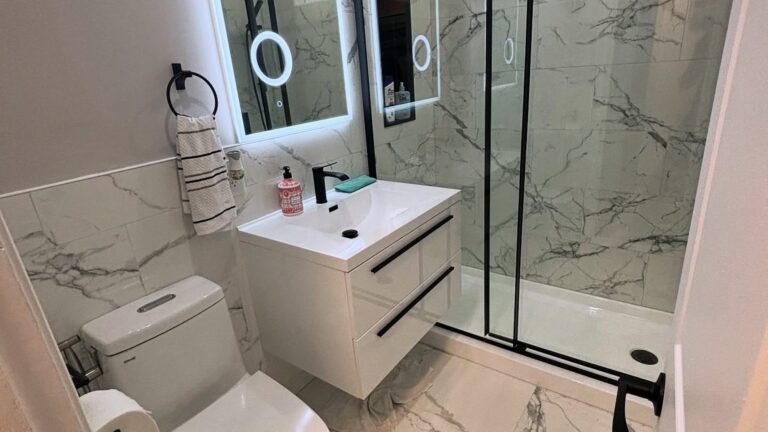
You walk past the guest bathroom and something stops you cold. A smell. Not stinky towels, not stale air. Rotten eggs. Sharp, ugly, wrong.
You crack the door and it hits harder. Under the sink, dry. Toilet lid up, clean. You sniff along the baseboard, half worried there’s a dead mouse in the wall. Nothing is leaking. Nothing looks broken. But the smell is real, and it’s definitely coming from inside that room.
So you do what most of us do. You Google it. In about four minutes flat, you’ve talked yourself into a cracked sewer line, a dead animal rotting in the drywall, or a busted seal under the toilet leaking sewage into your floor. You picture the bill. You start looking up plumbers.
But a friend of mine paid $180 for that exact smell last spring. The plumber walked into her guest bathroom, turned on the faucet for half a minute, and left. He wrote two words on the invoice and drove away. She’s never paid for that smell again.

First, what is that smell?
That rotten-egg stink has a name. It’s hydrogen sulfide gas, one of the main gases in what plumbers just call sewer gas. According to the Illinois Department of Public Health, it comes from waste breaking down, and one way it sneaks into a home is through drains that have gone dry [1].
Your nose is a monster at spotting this stuff. The CDC’s toxic substances division (ATSDR) says people can smell hydrogen sulfide at levels as low as 0.0005 parts per million [2]. That’s absurdly low, which is why a tiny bit of it in a small bathroom hits like a slap in the face.
At the levels you’d smell in a normal guest bath, you’re mostly looking at eye and throat irritation and maybe a headache. But it’s a real warning that something outside your walls is finding its way in.
Why this call bugs plumbers so much
The smell almost always shows up in the same few spots: a guest bathroom nobody has used in a month. A basement floor drain. A laundry sink. A vacation home you just got back to. A rental sitting empty between tenants. Not a coincidence. A fingerprint.

Meanwhile the bill hurts. According to Angi’s 2025 plumbing cost data, the average homeowner spends around $338 on a plumber visit, with just the service call (the truck showing up) running $100 to $250 on its own [3]. A peer-reviewed study published through the U.S. National Institutes of Health calls out dry drains as one of the main ways sewer gas gets into homes, right alongside a bad toilet seal or cracked pipe [4].
The bill is real. The cause, on most of these calls, is something you could have fixed yourself before dinner.
The part almost every homeowner gets wrong
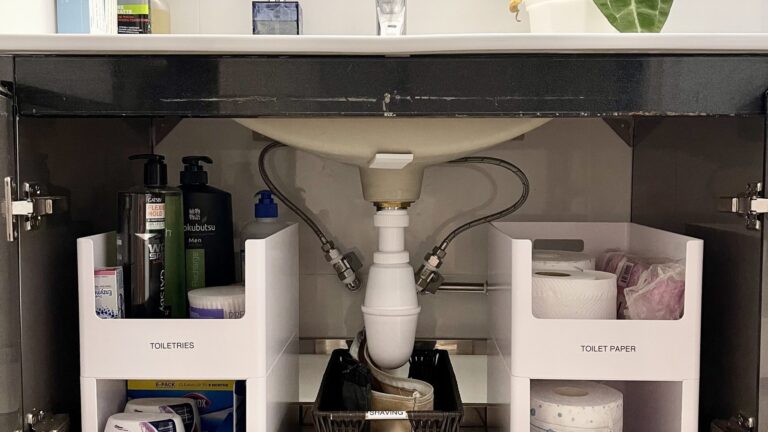
Every drain in your house has a bent piece of pipe under it. Open the cabinet under your bathroom sink and you’ll see it. That U-shape or J-shape is called a P-trap, and it exists to do exactly one job.
Sitting inside that bend is a small pool of water, about two to four inches deep (roughly 5 to 10 cm). That pool is a liquid seal, a wall of water blocking sewer gas from crawling up out of the main drain pipe and into your bathroom. Every drain in your house eventually joins the same big waste pipe running to the city sewer or septic tank, and that pipe is full of hydrogen sulfide, methane, and whatever else is rotting downstream. The only thing keeping that gas out of your face is the puddle in each trap.
And here’s the problem: that water dries up.
In a drain you use every day, it never matters. Every hand-wash and flush tops the trap back up. But in a bathroom nobody has touched in a month, the water quietly evaporates a little more each day until it drops below the bottom of the bend. The seal breaks. And the second it breaks, you’ve got an open pipe running from your sink straight down into the sewer. Sewer gas walks right up it.
The City of North Richland Hills, Texas, spells it out in their public health guide: fix cracked traps, run water through every fixture on a regular schedule, and sewer gas can’t get into your living space [5]. Water in the bend, seal holds, no smell. Water gone, seal gone, smell.
The 30-second fix
If a bathroom, laundry room, or basement drain in your house smells like rotten eggs and nobody has been using it, do this before anything else:
- Turn on every sink, shower, and floor drain in that room. Let each one run about 30 seconds. Move to the next one.
For a floor drain with no faucet over it, pour about a gallon of water in from a bucket (roughly 4 liters). For a shower or tub nobody uses, let the water run a full 30 seconds so it actually gets past the grate and into the pipe.
That’s it. You’re refilling the puddle in the bend under each drain and rebuilding the seal. The smell should be noticeably better in a few hours, and often gone in minutes.
To keep it from creeping back: run water in every unused drain for 30 seconds, once a month. Set a repeating phone reminder. That’s the whole plan.
For a home you’re leaving empty longer (a vacation house you close for winter, a place between tenants), there’s an old plumber trick. After you refill the trap, pour a few tablespoons of mineral oil or cooking oil into the drain. The oil floats on the water and slows evaporation way down. According to that same North Richland Hills guide, this can hold a seal for months instead of weeks [5]. A $2 fix for a house nobody is visiting.
When it’s actually something else
Run the water. Wait a few hours. If the smell is gone and stays gone, you had a dry trap and you’re done.
If it doesn’t go away, or comes back within a day or two even with the room getting normal use, it’s not a dry trap. The usual suspects are:
- A cracked or leaking P-trap dripping onto the cabinet floor faster than you can refill it.
- A blocked plumbing vent on your roof (bird’s nest, leaves) that’s actually sucking water out of your traps.
- A failed wax ring under the toilet, letting gas leak around the base (look for slight staining on the floor around the bowl).
- A real break in the drain line inside a wall or under the slab. Rare, but it happens.
Those need a plumber. But you’ve already knocked out the most likely cause for free, before paying anyone to tell you the same thing.
Sources: (1) Illinois Department of Public Health, Hydrogen Sulfide Gas; (2) Agency for Toxic Substances and Disease Registry (CDC), Hydrogen Sulfide ToxFAQs; (3) Angi, How Much Does Plumbing Repair Cost? 2025 Data; (4) Sewer Gas: An Indoor Air Source of PCE to Consider During Vapor Intrusion Investigations, PMC / NIH; (5) City of North Richland Hills Consumer Health Division, Sewer Gas Smell Explained.